In today’s digital economy, downtime is more than an inconvenience — it’s lost revenue, broken trust, and frustrated teams. Dropped calls, frozen video meetings, and persistent connectivity issues have become the daily headaches of IT managers and CTOs across industries.
Even companies that invest in multiple ISPs often discover that traditional load balancing can’t deliver seamless uptime. Sessions still fail when a line goes down, leaving businesses exposed at critical moments. So when multiple ISPs and load balancing still fall short, what’s the real solution for uninterrupted connectivity?
The answer is WAN Bonding — a packet‑level technology that fuses multiple internet connections into one resilient, high‑performance pipeline.
This post shows how WAN Bonding transforms connectivity, moving businesses from frustration to confidence, and shares real‑world case studies that prove its impact.
When Load Balancing and Failover Aren’t Enough
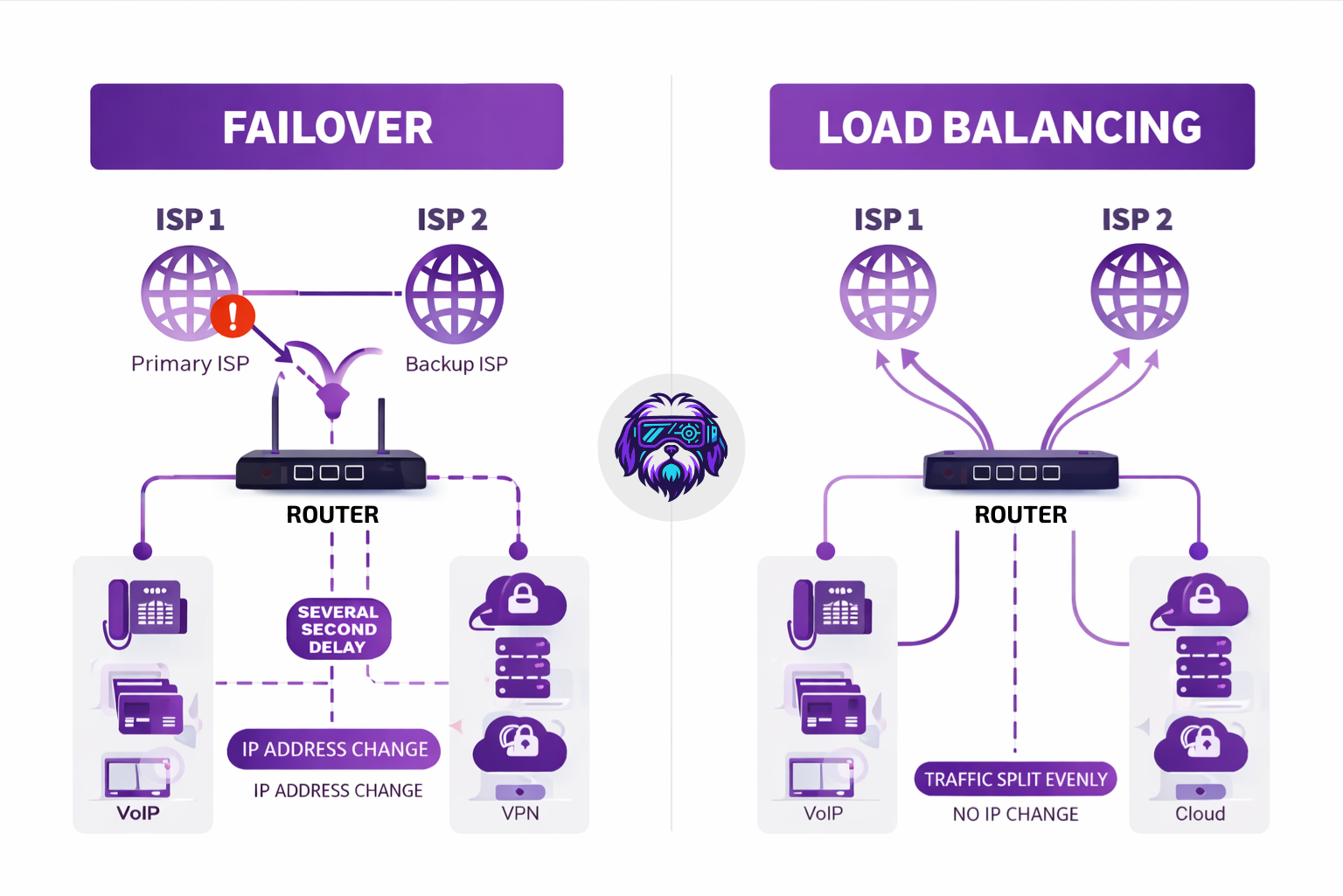
Even with dual ISPs, VoIP calls still drop. Why? Because load balancing distributes sessions, not packets. Each call or video stream is tied to a single line, so when that line fails, the session fails too.
Some businesses rely on failover instead, but failover isn’t an active backup — it only switches to the secondary connection after the primary one goes down. That switchover introduces a delay of several seconds, which is enough to disconnect calls, freeze video meetings, or interrupt payment transactions. In other words, failover keeps you online eventually, but not seamlessly.
WAN Bonding changes the game by aggregating bandwidth at the packet level. It keeps all connections active at once, distributing traffic intelligently so that even if one line fails, sessions continue without interruption. The result is zero‑drop connectivity and stronger performance for critical applications.
For IT leaders searching for true internet redundancy, WAN Bonding offers the clear answer: seamless uptime, bandwidth aggregation, and reliability that load balancing and failover simply can’t deliver.
Why Failover Falls Short
Failover is often assumed to provide seamless failover or redundancy, but in reality it’s a reactive mechanism. When the primary ISP fails, traffic is rerouted to the backup connection — but this switchover takes several seconds. That delay is enough to drop VoIP calls, freeze video meetings, or interrupt payment transactions.
Another hidden issue: when failover switches to the backup ISP, the network also switches to a different public IP address. This disrupts sessions tied to the original IP, such as secure logins, VPN tunnels, or cloud services. For businesses that rely on continuous connectivity, this IP change is a serious drawback.
Why Load Balancing Isn’t Aggregation
Load balancing spreads traffic across multiple ISPs, but each session is still tied to a single line.
That means:
- No true speed aggregation — file downloads or video streams only use the bandwidth of one ISP at a time.
- Interrupted downloads — if the primary ISP fails mid‑download, the session breaks before failover can switch, forcing the download to restart from scratch.
Together, failover and load balancing provide partial solutions, but neither can deliver the seamless uptime or combined bandwidth that modern businesses expect.
Dual‑ISP Routers Are Not WAN Bonding
Many routers marketed as dual‑ISP or multi‑WAN devices are often misunderstood. Models like the TP‑Link ER605, for example, support load balancing and failover, but they are not true WAN Bonding routers. These devices can switch between connections or distribute sessions across them, yet they don’t merge multiple ISPs into a single, unified stream.
That means you still face the same limitations: delays during failover, public IP changes when switching, and no aggregation of bandwidth for downloads or real‑time applications.
Why WAN Bonding Is Different
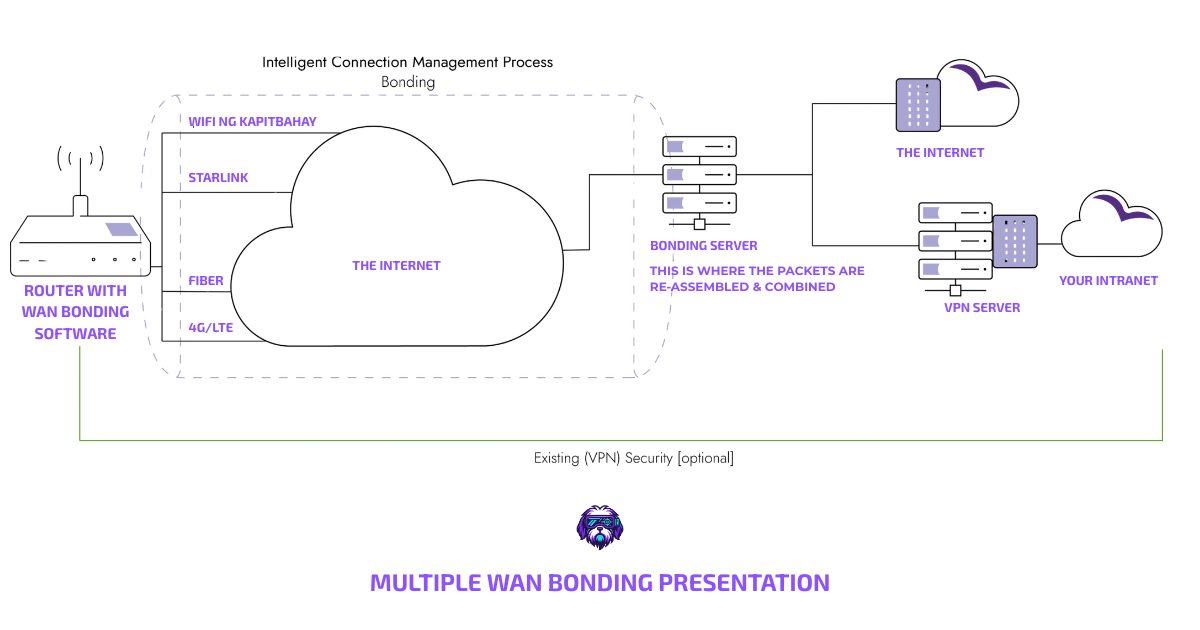
WAN Bonding keeps all connections active simultaneously, distributing traffic at the packet level.
This ensures:
- Zero‑drop connectivity — sessions continue even if one ISP fails.
- True bandwidth aggregation — downloads, streams, and cloud apps can use the combined speed of all ISPs.
- Stable public IP — traffic flows through a single bonded IP, avoiding the disruptions caused by failover switching.
For businesses, this translates into uninterrupted payments, reliable communications, and faster cloud access — benefits that load balancing and failover simply cannot match.
Failover vs. Load Balancing vs. WAN Bonding
When businesses look for internet redundancy, the terms failover, load balancing, and WAN Bonding often get mixed together. On the surface, they all promise reliability, but in practice they deliver very different results.
The table below breaks down how each approach works, where it falls short, and why WAN Bonding stands apart as the only solution that truly combines multiple ISPs into one seamless, high‑performance connection.
| Approach | How It Works | Key Limitations | Business Impact |
|---|---|---|---|
| Failover | Switches traffic to a backup ISP when the primary fails | Delay of several seconds during switchover; changes public IP address | Dropped calls, broken VPNs, interrupted payments |
| Load Balancing | Distributes sessions across multiple ISPs | No true speed aggregation; each session tied to one line | Downloads fail mid‑session; limited performance gains |
| WAN Bonding | Combines multiple ISPs at the packet level into one stream | Requires specialized bonding hardware/software and a VPS bonding server | Zero‑drop connectivity, stable public IP, aggregated bandwidth |
Only WAN Bonding eliminates downtime while boosting performance — making it the clear choice for modern businesses.
Unlike consumer‑grade dual‑ISP routers, WAN Bonding requires a bonding server — often hosted on a VPS — to act as the aggregation point.
This server receives packets from all active connections, reassembles them into a single stream, and presents one stable public IP to the outside world.
That’s why WAN Bonding can deliver true bandwidth aggregation and uninterrupted sessions, while failover and load balancing cannot.
Evaluating WAN Bonding: Finding Your “Unbreakable” Connection
By now, you likely realize that standard failover and load balancing aren’t enough. When a connection drops, even a 5‑second “re‑connect” delay is still a failure in the eyes of a client, a remote team, or a live audience.
WAN Bonding solves this problem — but not every platform is built for the same environment.
Whether you need enterprise‑grade hardware integration, a software‑only mobile solution, or a transparent open‑source build, the right choice depends on your hardware stack, budget, and technical requirements.
Use the matrix below to compare the top four industry standards for network resilience.
WAN Bonding Solutions: The Comparison Matrix
Before diving into the matrix, here’s a quick overview of the four leading WAN Bonding platforms:
- Bondix by SIMA: German‑engineered, officially partnered with Teltonika Networks. Specializes in packet‑level bonding for industrial and mission‑critical environments.
- Speedify: Software‑based bonding service designed for simplicity. Popular among SMBs, streamers, and mobile teams. Runs on PCs, Macs, mobile devices, and GL.iNet routers.
- OpenMPTCProuter: Open‑source project built around Multipath TCP. Appeals to technical users and DIY enthusiasts who want transparency, flexibility, and cost savings.
- Peplink SpeedFusion: Premium SD‑WAN technology integrated into Peplink routers. Offers Hot Failover, WAN Smoothing, and Bandwidth Aggregation for mission‑critical deployments.
| Feature | Bondix by SIMA | Speedify | OpenMPTCProuter | Peplink SpeedFusion |
|---|---|---|---|---|
| Primary Use Case | Mission‑critical / Industrial | SMB / Mobile Live Streamers | Technical / DIY / Cost‑Saving | Enterprise / Mission‑Critical / Mobile Command |
| Best Hardware Fit | Teltonika & Digi Networks | PC, Mac, iOS, Android, GL.iNet | Raspberry Pi, x86, Generic | Peplink Routers & Appliances |
| Deployment | Managed / Professional | Plug‑and‑Play (SaaS) | Self‑Hosted / Community | Hardware‑Integrated / Enterprise SD‑WAN |
| Bonding Method | Packet‑level / Low Latency | Software‑defined / Speed focused | MPTCP / Aggregation Proxy | SpeedFusion Bonding, Hot Failover, WAN Smoothing |
| Support Model | Official Partner Support | Standard Ticket Support | Community‑Driven / GitHub | Enterprise Support / Global Partner Network |
| Licensing | Per‑device License | Subscription‑based | Free / Open Source | Hardware License / CarePlan Bundles |
Compatible Teltonika Routers to Run Bondix By SIMA
Bondix by SIMA, is a highly specialized client software that integrates directly into Teltonika Networks hardware. It is designed for industrial and mission-critical applications that require ruggedized performance.
- RUTC Series: Designed for compact yet capable deployments, including models like the RUTC50, which support advanced bonding scenarios with Bondix.
- RUTX Series: Optimized for high-performance models like the RUTX50 (5G), RUTX14 (Cat 12), and RUTX11.
- RUTM Series: Compatible with newer industrial mobile routers such as the RUTM50.
- Legacy & Compact Models: Fully supports established workhorses including the RUT950, RUT951, RUT955, and RUT956.Entry-Level Industrial: Even compact devices like the RUT240, RUT241, and RUT360 can run the Bondix client for essential bonding needs.
Compatible Hardware To Run Speedify
Speedify is a versatile, software-first solution. While it’s famously mobile and desktop-friendly, it can be deployed at the network level on specific hardware to bond connections for an entire office or home.
- Raspberry Pi: A popular choice for DIY bonding; specifically Raspberry Pi 4 and 5 running Raspberry Pi OS or OpenWrt.
- GL.iNet Routers: Native support is available for travel routers like the GL-MT3000 (Beryl AX) and GL-MT1300 (Beryl).
- Mini PCs & Servers: Any x86_64 (Intel/AMD) machine running Ubuntu or Debian can act as a high-speed bonding gateway.
- OpenWrt Devices: Compatible with various routers running OpenWrt 23.05+, provided they use aarch64 or x86_64 architectures.
Compatible Hardware to Run OpenMPTCProuter
OpenMPTCProuter (OMR) is the go-to for users who want a powerful, open-source solution. Because it aggregates traffic at the packet level, it requires hardware with enough CPU overhead to handle the encryption and MPTCP protocols.
- Single-Board Computers (SBCs): Raspberry Pi 4 and 5 are the most widely used and tested platforms.
- x86_64 Mini PCs: For maximum stability and throughput, Intel/AMD-based Mini PCs are recommended as the primary testing platform for new releases.
- Specialized Router Hardware: Support includes platforms like the ZBT Z8102AX and beta support for the Netgear R7800.
- Ubiquiti EdgeRouter: Has seen “alpha” level support for models like the EdgeRouter X, though SBCs or Mini PCs are generally preferred for stability.
Choosing the Right WAN Bonding Solution for Your Business
By now, you understand the technical capabilities of each platform.
The final question is:
Which one fits your specific operational needs? Use the decision matrix below to find your match.
The Decision Matrix: Which Solution is for You?
Navigating the trade-offs between reliability, cost, and ease of use is critical for a successful deployment. This matrix simplifies the evaluation process, helping you align your specific operational priorities with the strengths of each bonding solution.
| If your priority is… | Bondix by SIMA | Speedify | OpenMPTCProuter | Peplink SpeedFusion |
|---|---|---|---|---|
| 99.99% Industrial Uptime | Best | Good | Variable | Best |
| “Set & Forget” Simplicity | Best | High | Low | High |
| Instant 5-Minute Setup | Yes | Best | No | No |
| Zero Software Licensing Costs | No | No | Best | No |
| Professional 24/7 Support | Best | Ticket-based | Community Only | Best |
| Native Teltonika Integration | Best | No | Partial | No |
| Enterprise Hardware Integration | Partial | No | No | Best |
How to use this matrix:
- Choose Bondix if your priority is operational continuity and you require a professional, supported solution for industrial environments.
- Choose Speedify if you need immediate speed on consumer or mobile hardware with minimal technical configuration.
- Choose OpenMPTCProuter if you want a high-performance, open-source stack managed by an expert to eliminate technical overhead.
Ready to Eliminate Downtime?
Selecting the right software is only half the battle—proper deployment is what ensures 99.99% uptime. Whether you need a rugged Bondix configuration for a fleet or a custom-built OpenMPTCProuter gateway, I can help you architect, deploy, and manage the perfect setup.
Deployment & Managed Service Packages
To ensure your bonding solution is optimized for your specific environment, I offer tiered consultation and managed deployment services. All pricing is anchored in Euros (€) to serve our international partners in Ireland, the UK, and Europe.
Service Tiers
| Service Level | Description | Rate (EUR) |
|---|---|---|
| Discovery Call | 30-min deep dive into hardware/network requirements. | €45 |
| Standard Deployment | Remote configuration for single-site Bondix or Speedify. | €195 |
| Managed OMR Build | I handle the VPS: Setup, Hardening, and OMR Build. | €395 |
| Monthly Management | VPS Hosting, Security Patches, and Usage Monitoring. | €30/mo |
Special Localization: The “Home Base” Discount
As part of my commitment to supporting the local networking community in the Philippines, I offer a 30% “Home Base” discount on all Standard and Managed deployment services for projects based in the Philippines (PH). This discount is applied to the Euro base rate and converted to PHP for local convenience.
Note: This discount applies to labor and consultation fees only and is converted to PHP at the prevailing mid-market rate at the time of invoicing.
How to Book Your Session
- Select Your Tier: Choose the package that fits your project scale.
- Submit Your Details: Use the Consultation Intake Form to share your hardware specs and current challenges.
- Confirm & Deploy: I will reach out within 24 hours to schedule your session and provide a formal invoice in your preferred currency.
Why work with a specialist? WAN bonding is highly sensitive to latency, jitter, and MTU settings. A “script-only” or misconfigured setup often leads to packet fragmentation and dropped connections. My managed service guarantees a stable, professionally tuned link that handles the server-side complexity so you don’t have to.
Terms of Service & Engagement
- Hardware Ownership: The client is responsible for all physical on-site hardware (Routers/SBCs/SIMs).
- Third-Party Costs: Additional ISP data plans and external software licenses (Bondix/Speedify) are paid directly by the client.
- Managed VPS Infrastructure: For OMR builds, I handle the VPS provisioning. While I ensure server-side optimization, I am not liable for outages caused by upstream Data Center providers.
- Data Caps & Overages: Client is responsible for monitoring usage. Any excess bandwidth charges from the VPS provider will be passed through to the client at cost.
- Payment: Fees are billed in EUR (or PHP via discount) and are non-refundable once work begins. Monthly management fees are billed in advance.